10 CUDA
Links
Individual Contributions
Justus Dreßler: all members contributed equally
Thorsten Kröhl: all members contributed equally
Julius Halank: all members contributed equally
Project Plan for CUDA Implementation
Introduction: This project plan aims to implement Nvidia CUDA technology within a tight four-week timeframe to accelerate our tsunami simulations. The plan outlines realistic goals, milestones, work packages, and a schedule to efficiently execute the CUDA integration process.
What is CUDA?
CUDA is NVidias programming API for their GPUs. GPU’s are highly parallelized and can therefore be used to accelerate certain tasks. Our workload is very well suited for this kind of acceleration, as we have to perform the same calculations on a large amount of data. CUDA comes with a lot of tools to help with the development process, such as a profiler, which we will use to optimize our code. We will implement the C++ version of CUDA, which is called CUDA C++.
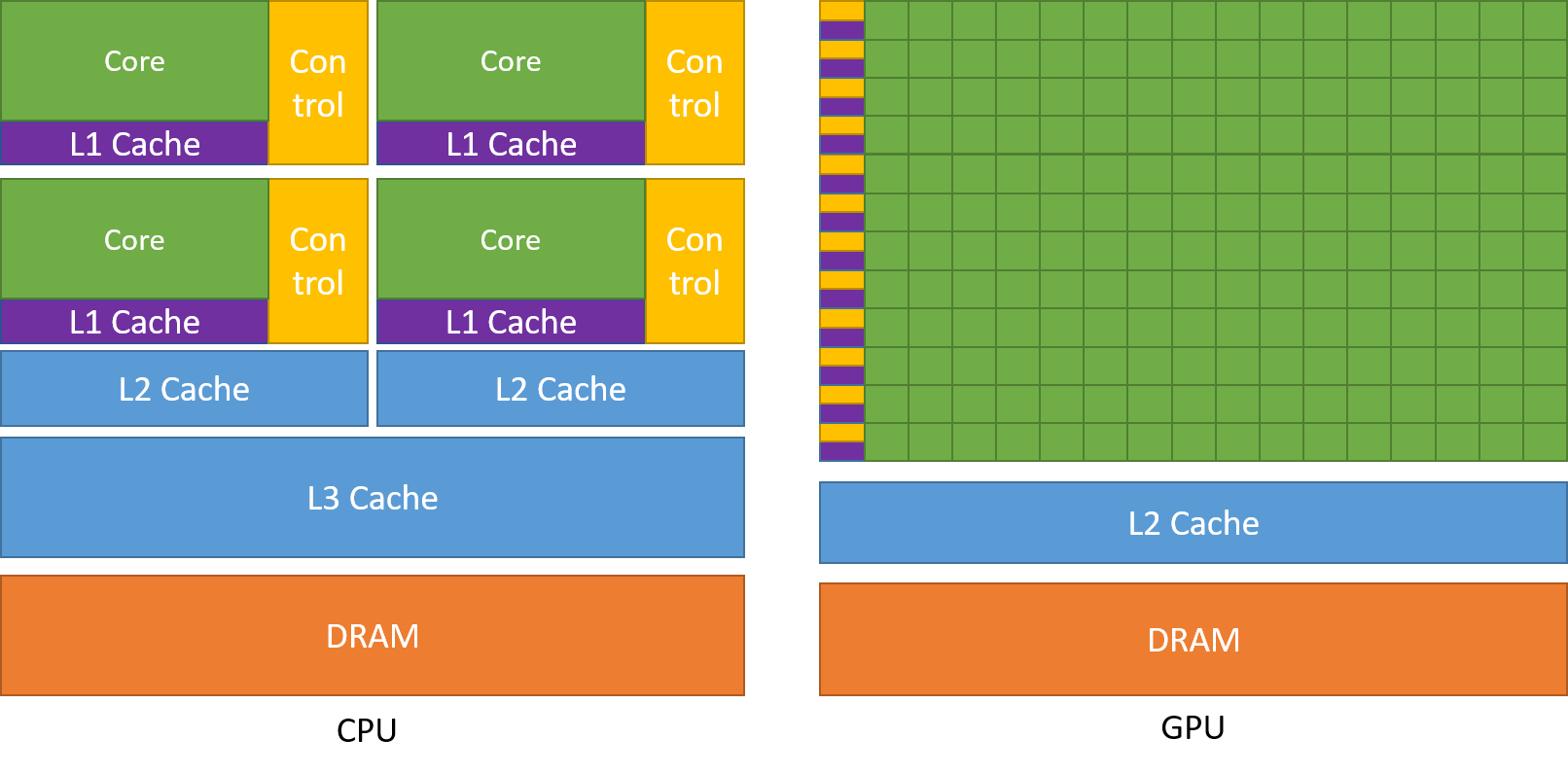
CPU vs GPU architecture
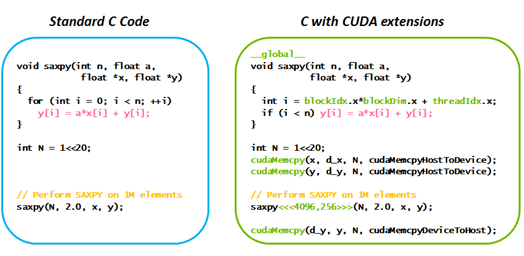
Extending C code with CUDA
Goals
Acceleration: Implement CUDA to significantly accelerate tsunami simulations by a factor of at least 2 compared to multithreaded CPU processing.

Our completely not made up expected performance improvement graph
Compatibility: Ensure CUDA integration without compromising calculation accuracy or functionality.
Milestones with work packages and estimated time
MS-1 Preparation Package (Week 1) :
- Literature Review:
Conduct a brief literature review to gain fundamental knowledge about CUDA
Summarize relevant information for the team
- Test Programs with CUDA Implementation:
Create small test programs to understand the basic concepts of CUDA
Document results and experiences for the team
MS-2 Framework Analysis and Modification Package (Week 2) :
- Identification of Key Areas:
Analyze the existing Tsunami simulation framework to identify key areas for CUDA integration
Document identified areas and their significance
- Codebase Modification and Initial Kernel Development:
Modify the codebase for smooth integration of CUDA parallelization
Initiate the development of initial CUDA kernels for identified simulation components
Document changes and initial kernel developments
MS-3 CUDA Implementation Package (Week 3) :
- Development of CUDA Kernels:
Develop CUDA kernels for individual simulation components based on identified key areas
Document kernel development and implemented functions
- Initial Tests for Performance Improvement:
Conduct initial tests to identify performance improvements resulting from CUDA implementation
Analyze test results and document observed enhancements
MS-4 Optimization and Testing Package (Week 4) :
- Optimization of CUDA Code:
Optimize the developed CUDA code to enhance efficiency
Utilize profiling tools such as NVPROF for detailed analysis and optimization
- Comprehensive Validation Tests:
Conduct comprehensive tests to validate calculation accuracy after CUDA implementation
Document test results and validate performance improvements compared to previous simulations