8 Optimization
Links
Individual Contributions
Justus Dreßler: all members contributed equally
Thorsten Kröhl: all members contributed equally
Julius Halank: all members contributed equally
8.1 ARA
8.1.1 Upload and Compile Code on Cluster
We uploaded our code via git clone and wget the tar.xz file from the uni-cloud.
We then untarred the file and ran the following batch script to compile the code:
#!/bin/bash
#SBATCH --job-name=tsunami_lab_reis
#SBATCH --output=tsunami_lab_reis.output
#SBATCH --error=tsunami_lab_reis.err
#SBATCH --partition=s_hadoop,s_standard
#SBATCH --nodes=1
#SBATCH --ntasks=1
#SBATCH --time=11:00:00
#SBATCH --cpus-per-task=72

# Load any necessary modules (if needed)
# module load mymodule
module load tools/python/3.8
module load compiler/gcc/11.2.0
module load compiler/intel/2020-Update2
python3.8 -m pip install --user scons
python3.8 -m pip install --user distro

# Enter your executable commands here
# Execute the compiled program
date
cd /beegfs/gi24ken/tsunami_lab
scons comp=icpc
./build/tsunami_lab -i -t 10 -u "Tsunami2d output/tohoku_gebco20_usgs_250m_displ.nc output/tohoku_gebco20_usgs_250m_bath.nc 18000" 4000
8.1.2 Run different scenarious and batch jobs
We already ran Chapter 6 50/50 on Ara and on our home PC’s and didn’t see any difference in output quality.
8.1.3 Compare time consumption to your local pc and add a timer for each steps
All configurations were run with ./build/tsunami_lab -i -t 10 -u "Tsunami2d output/tohoku_gebco20_usgs_250m_displ.nc output/tohoku_gebco20_usgs_250m_bath.nc 18000" 4000.
(Tohoku, 4000m Cellsize, no FileIO)
Methodology: We ran the program 3 times and took the average of the 3 runs.
Ara: Skylake Intel(R) Xeon(R) Gold 6140 CPU @ 2.30GHz
Configuration |
Time per Cell and Iteration |
|---|---|
g++ -Ofast -g -march=native -mtune=native after optimizations |
28.0ns |
g++ -Ofast -g -march=native -mtune=native |
43.3ns |
g++ -Ofast -g |
48.3ns |
g++ -O3 -g |
51.0ns |
g++ -O2 -g |
54.3ns |
g++ -O1 -g |
73.0ns |
g++ -O0 -g |
172.3ns |
Home-PC Justus Dreßler: Coffee Lake Intel(R) Core(TM) i5-8600K CPU @ 3.60GHz
Disclaimer: We commented out code involving std::filesystem::directory_iterator because icpc seems to not handle its library.
The code shouldn’t be touched in the runtime (disabled fileIO) but it may result in a smaller binary.
Configuration |
Time per Cell and Iteration |
|---|---|
g++ -Ofast -g -march=native -mtune=native after optimizations |
25.0ns |
g++ -Ofast -g -march=native -mtune=native |
39.3ns |
icpc -Ofast -g -march=native -mtune=coffeelake |
41.3ns |
icpc -Ofast -g -march=native -mtune=coffeelake -ipo |
41.7ns |
g++ -O3 -g -march=native -mtune=native |
43.3ns |
g++ -Ofast -g |
44.3ns |
icpc -O3 -g |
44.7ns |
icpc -Ofast -g |
45.0ns |
icpc -O2 -g |
47.3ns |
g++ -O3 -g |
47.3ns |
g++ -O2 -g |
49.0ns |
g++ -O1 -g |
66.3ns |
icpc -O1 -g |
72.7ns |
g++ -O0 -g |
153.0ns |
icpc -O0 -g |
208.3ns |
Ara seems to be roughly 10% slower than Justus Dreßler’s home PC i5-8600K (without background programs running).
8.2 Compiler
8.2.1 Add support for generic compilers to your build script
We currently don’t leak the build environment into the scons script.
(It seems to be discouraged by the SCons developers.)
Instead we use the arguments comp=g++ / comp=icpc and cxxO=-OX to set the compiler and optimization level.
This does impose limitations on the compiler since SCons doesn’t look into the path but searches itself, so we need to provide the exact install locations.
So we currently only support icpc and g++.
# set compiler
cxxCompiler = ARGUMENTS.get('comp', "g++")

# workaround to find the right g++ version on Ara
if 'centos' == distro.id():
  if cxxCompiler == 'g++':
    print('running on Ara, using gcc-11.2.0')
    env.Replace(CXX="/cluster/spack/opt/spack/linux-centos7-broadwell/gcc-10.2.0/gcc-11.2.0-c27urtyjryzoyyqfms5m3ewi6vrtvt44/bin/g++")
  else:
    print('running on Ara, using icpc-19.1.2.254')
    env.Replace(CXX="/cluster/intel/parallel_studio_xe_2020.2.108/compilers_and_libraries_2020/linux/bin/intel64/icpc")
else:
  if cxxCompiler == 'g++':
    pass
  else:
    env.Replace(CXX="icpc")

# add default flags
env.Append( CXXFLAGS = [ '-std=c++17',
                           '-Wall',
                           '-Wextra',
                           '-g',
                           '-march=native',
                           '-mtune=native',
                           '-Werror',])
if( 'g++' == cxxCompiler ):
  env.Append( CXXFLAGS = [ '-Wpedantic' ] )
else:
  env.Append( CXXFLAGS = ['-diag-disable=10441',
                           '-wd823'])

# set optimization mode
if 'debug' in env['mode']:
  env.Append( CXXFLAGS = [ '-g',
                           '-O0' ] )
  print( 'using optimization flag: -O0 -g' )
else:
  cxxOptimization = ARGUMENTS.get('cxxO', "-O3")
  env.Append( CXXFLAGS = [ cxxOptimization ] )
  print( 'using optimization flag: ' + cxxOptimization )
8.2.2 & 8.2.3 Compare recent GNU and Intel compilers
We used g++ Version 11.2.0 and icpc Version 19.1.2 on Ara and g++ Version 11.4.0 and icpc Version 2021.10.0 (Intel OneApi) on our home PC’s.
See 8.1.3 Compare time consumption to your local pc and add a timer for each steps for the results.
The results for each compiler are as expected (higher optimization level = faster code).
The -ipo flag for icpc didn’t seem to have any effect on the runtime.
If we compare both compilers between each other icpc seemed genereally slightly faster than g++ except on the highest optimization level.
With -Ofast -g -march=native -mtune=native g++ beat out icpc by a solid 5%.
g++ also won in the compatibility of the code, as icpc for some reason couldn’t link to std::filesystem::directory_iterator and we had to comment out the code involving it.
This is probably caused by icpc using g++’s standard library and not shipping with its own.
For the following abstract we used GCC’s Docs on Optimization.
Regarding numerical accuracy the only problematic flag should be (disregarding compiler bugs) -Ofast since it turns on -ffast-math and -fallow-store-data-races.
-ffast-math turns on -fno-math-errno, -funsafe-math-optimizations , -ffinite-math-only, -fno-rounding-math, -fno-signaling-nans, -fcx-limited-range and -fexcess-precision=fast.
-fno-math-errnoshould be numerically safe for our program as we don’t read outerrnoat any point.-funsafe-math-optimizationsis a potential hazard regarding numerical accuracy as it turns on-fno-signed-zeros,-fno-trapping-math,-fassociative-math`and-freciprocal-math.-fno-signed-zerosshould be harmless as we shouldn’t rely on the sign of0.0at any point of the code.-fno-trapping-mathshould be harmless as long as we test the code before without it as there shouldn’t be any traps thrown while running.-fassociative-mathis a potential hazard as floating-point math is naturally not associative and it could change the numeric stability of our operations potentially.-freciprocal-mathis a potential hazard as it lowers the accuracy of some divide operations.
-ffinite-math-onlyshould be harmless since the results should at no point be NaN nor +-inf.-fno-rounding-mathis the default and shouldn’t affect anything (we don’t change our rounding mode dynamically).-fno-signaling-nansis the default and shouldn’t affect anything.-fcx-limited-rangeshould be harmless since we don’t use complex arithmetic.-fexcess-precision=fastis a minor potential hazard as it changes rounding behavior if higher precision math is faster on some operations.
-fallow-store-data-races should be harmless since we currently aren’t using multiple threads so no races should be able to occur.
8.2.4 Make yourself familiar with optimization reports and add an option for them in your build script
The optimization reports of icpc -O3 -g show that the FWave::netUpdates() is fully inlined (except memsets) but its not inlined into WavePropagation2d::timeStep().
INLINE REPORT: (tsunami_lab::solvers::FWave::netUpdates(tsunami_lab::t_real, tsunami_lab::t_real, tsunami_lab::t_real, tsunami_lab::t_real, tsunami_lab::t_real, tsunami_lab::t_real, tsunami_lab::t_real *, tsunami_lab::t_real *)) [5/6=83.3%] build/src/solvers/fWave/FWave.cpp(105,1)
-> INLINE: (140,5) tsunami_lab::solvers::FWave::waveSpeeds(tsunami_lab::t_real, tsunami_lab::t_real, tsunami_lab::t_real, tsunami_lab::t_real, tsunami_lab::t_real &, tsunami_lab::t_real &) (isz = 22) (sz = 37)
  -> INLINE (MANUAL): (20,23) std::sqrt(float) (isz = 0) (sz = 7)
  -> INLINE (MANUAL): (21,23) std::sqrt(float) (isz = 0) (sz = 7)
  -> INLINE (MANUAL): (29,36) std::sqrt(float) (isz = 0) (sz = 7)
-> INLINE: (151,5) tsunami_lab::solvers::FWave::waveStrengths(tsunami_lab::t_real, tsunami_lab::t_real, tsunami_lab::t_real, tsunami_lab::t_real, tsunami_lab::t_real, tsunami_lab::t_real, tsunami_lab::t_real, tsunami_lab::t_real, tsunami_lab::t_real &, tsunami_lab::t_real &) (isz = 77) (sz = 100)
  -> EXTERN: (68,25) ?1memset
  -> INLINE: (81,5) tsunami_lab::solvers::FWave::flux(tsunami_lab::t_real, tsunami_lab::t_real, tsunami_lab::t_real &, tsunami_lab::t_real &) (isz = 4) (sz = 15)
  -> INLINE: (82,5) tsunami_lab::solvers::FWave::flux(tsunami_lab::t_real, tsunami_lab::t_real, tsunami_lab::t_real &, tsunami_lab::t_real &) (isz = 4) (sz = 15)
  -> INLINE: (83,5) tsunami_lab::solvers::FWave::deltaXPsi(tsunami_lab::t_real, tsunami_lab::t_real, tsunami_lab::t_real, tsunami_lab::t_real, tsunami_lab::t_real &) (isz = 1) (sz = 14)
-> EXTERN: (163,23) ?1memset
-> EXTERN: (164,23) ?1memset
Optimization Report of FWave::netUpdates()
INLINE REPORT: (tsunami_lab::patches::WavePropagation2d::timeStep(tsunami_lab::patches::WavePropagation2d *, tsunami_lab::t_real)) [13/24=54.2%] build/src/patches/wavePropagation2d/WavePropagation2d.cpp(56,1)
-> INLINE: (57,3) tsunami_lab::patches::WavePropagation2d::setGhostCellsX(tsunami_lab::patches::WavePropagation2d *) (isz = 297) (sz = 302)
  -> INLINE: (185,11) tsunami_lab::patches::WavePropagation2d::getCoord(tsunami_lab::patches::WavePropagation2d *, tsunami_lab::t_idx, tsunami_lab::t_idx) (isz = 1) (sz = 11)
  /* more getCoord inlines */
  -> INLINE: (222,11) tsunami_lab::patches::WavePropagation2d::getCoord(tsunami_lab::patches::WavePropagation2d *, tsunami_lab::t_idx, tsunami_lab::t_idx) (isz = 1) (sz = 11)
-> INLINE: (70,14) tsunami_lab::patches::WavePropagation2d::getCoord(tsunami_lab::patches::WavePropagation2d *, tsunami_lab::t_idx, tsunami_lab::t_idx) (isz = 1) (sz = 11)
/* more getCoord inlines */
-> INLINE: (80,21) tsunami_lab::patches::WavePropagation2d::getCoord(tsunami_lab::patches::WavePropagation2d *, tsunami_lab::t_idx, tsunami_lab::t_idx) (isz = 1) (sz = 11)
-> EXTERN: (87,9) tsunami_lab::solvers::FWave::netUpdates(tsunami_lab::t_real, tsunami_lab::t_real, tsunami_lab::t_real, tsunami_lab::t_real, tsunami_lab::t_real, tsunami_lab::t_real, tsunami_lab::t_real *, tsunami_lab::t_real *)
-> EXTERN: (98,9) tsunami_lab::solvers::Roe::netUpdates(tsunami_lab::t_real, tsunami_lab::t_real, tsunami_lab::t_real, tsunami_lab::t_real, tsunami_lab::t_real *, tsunami_lab::t_real *)
-> INLINE: (114,3) tsunami_lab::patches::WavePropagation2d::setGhostCellsY(tsunami_lab::patches::WavePropagation2d *) (isz = 297) (sz = 302)
  -> INLINE: (242,11) tsunami_lab::patches::WavePropagation2d::getCoord(tsunami_lab::patches::WavePropagation2d *, tsunami_lab::t_idx, tsunami_lab::t_idx) (isz = 1) (sz = 11)
  /* more getCoord inlines */
  -> INLINE: (279,11) tsunami_lab::patches::WavePropagation2d::getCoord(tsunami_lab::patches::WavePropagation2d *, tsunami_lab::t_idx, tsunami_lab::t_idx) (isz = 1) (sz = 11)
-> INLINE: (127,14) tsunami_lab::patches::WavePropagation2d::getCoord(tsunami_lab::patches::WavePropagation2d *, tsunami_lab::t_idx, tsunami_lab::t_idx) (isz = 1) (sz = 11)
/* more getCoord inlines */
-> INLINE: (137,21) tsunami_lab::patches::WavePropagation2d::getCoord(tsunami_lab::patches::WavePropagation2d *, tsunami_lab::t_idx, tsunami_lab::t_idx) (isz = 1) (sz = 11)
-> EXTERN: (144,9) tsunami_lab::solvers::FWave::netUpdates(tsunami_lab::t_real, tsunami_lab::t_real, tsunami_lab::t_real, tsunami_lab::t_real, tsunami_lab::t_real, tsunami_lab::t_real, tsunami_lab::t_real *, tsunami_lab::t_real *)
-> EXTERN: (155,9) tsunami_lab::solvers::Roe::netUpdates(tsunami_lab::t_real, tsunami_lab::t_real, tsunami_lab::t_real, tsunami_lab::t_real, tsunami_lab::t_real *, tsunami_lab::t_real *)
Currently our big loops in WavePropagation2d::timeStep() are not vectorized and its not quite clear how we’d inline them with FWave::netUpdates() being called in it.
LOOP BEGIN at build/src/patches/wavePropagation2d/WavePropagation2d.cpp(75,3)
  remark #15523: loop was not vectorized: loop control variable l_ex was found, but loop iteration count cannot be computed before executing the loop

  LOOP BEGIN at build/src/patches/wavePropagation2d/WavePropagation2d.cpp(76,5)
    remark #15523: loop was not vectorized: loop control variable l_ey was found, but loop iteration count cannot be computed before executing the loop
    remark #25456: Number of Array Refs Scalar Replaced In Loop: 1
  LOOP END
LOOP END
We were able to vectorize the simple copying loops though with #pragma omp simd.
// init new cell quantities
#pragma omp simd
for (t_idx l_cx = 1; l_cx < m_nCellsx + 1; l_cx++)
  for (t_idx l_cy = 1; l_cy < m_nCellsy + 1; l_cy++)
  {
    l_hNew[getCoord(l_cx, l_cy)] = l_hOld[getCoord(l_cx, l_cy)];
    l_huOld[getCoord(l_cx, l_cy)] = l_huNew[getCoord(l_cx, l_cy)]; // the real old data is in the hu_new
  }
Which shows up correctly in the optimization report:
LOOP BEGIN at build/src/patches/wavePropagation2d/WavePropagation2d.cpp(67,3)
  remark #15389: vectorization support: reference l_hNew[U19_V+1+l_cy*(this->m_nCellsx+2)] has unaligned access   [ build/src/patches/wavePropagation2d/WavePropagation2d.cpp(70,7) ]
  remark #15389: vectorization support: reference l_hOld[U19_V+1+l_cy*(this->m_nCellsx+2)] has unaligned access   [ build/src/patches/wavePropagation2d/WavePropagation2d.cpp(70,38) ]
  remark #15389: vectorization support: reference l_huOld[U19_V+1+l_cy*(this->m_nCellsx+2)] has unaligned access   [ build/src/patches/wavePropagation2d/WavePropagation2d.cpp(71,7) ]
  remark #15389: vectorization support: reference l_huNew[U19_V+1+l_cy*(this->m_nCellsx+2)] has unaligned access   [ build/src/patches/wavePropagation2d/WavePropagation2d.cpp(71,39) ]
  remark #15381: vectorization support: unaligned access used inside loop body
  remark #15305: vectorization support: vector length 8
  remark #15309: vectorization support: normalized vectorization overhead 0.923
  remark #15301: SIMD LOOP WAS VECTORIZED
  remark #15450: unmasked unaligned unit stride loads: 2
  remark #15451: unmasked unaligned unit stride stores: 2
  remark #15475: --- begin vector cost summary ---
  remark #15476: scalar cost: 9
  remark #15477: vector cost: 1.620
  remark #15478: estimated potential speedup: 5.100
  remark #15488: --- end vector cost summary ---

  LOOP BEGIN at build/src/patches/wavePropagation2d/WavePropagation2d.cpp(68,5)
    remark #15548: loop was vectorized along with the outer loop
  LOOP END
LOOP END
We are currently unsure why it assumes the arrays have unaligned access.
8.3 Instrumentation and Performance Counters
8.3.1-8.3.3 Analyze your code with VTune
The GUI produced the following commands for vtune:
# for threading
/cluster/intel/vtune_profiler_2020.2.0.610396/bin64/vtune -collect threading -app-working-dir /beegfs/gi24ken/tsunami_lab -- /beegfs/gi24ken/tsunami_lab/build/tsunami_lab -t 10 -u "Tsunami2d output/tohoku_gebco20_usgs_250m_displ.nc output/tohoku_gebco20_usgs_250m_bath.nc 18000" 4000
# for hotspots
/cluster/intel/vtune_profiler_2020.2.0.610396/bin64/vtune -collect hotspots -app-working-dir /beegfs/gi24ken/tsunami_lab -- /beegfs/gi24ken/tsunami_lab/build/tsunami_lab -t 10 -u "Tsunami2d output/tohoku_gebco20_usgs_250m_displ.nc output/tohoku_gebco20_usgs_250m_bath.nc 18000" 4000
We ran the command in a batch job with the following script (once for hotspots and once for threading):
#!/bin/bash
#SBATCH --job-name=tsunami_lab_reis
#SBATCH --output=tsunami_lab_reis.output
#SBATCH --error=tsunami_lab_reis.err
#SBATCH --partition=s_hadoop,s_standard
#SBATCH --nodes=1
#SBATCH --ntasks=1
#SBATCH --time=11:00:00
#SBATCH --cpus-per-task=72

# Load any necessary modules (if needed)
# module load mymodule
module load tools/python/3.8
module load compiler/gcc/11.2.0
module load compiler/intel/2020-Update2
python3.8 -m pip install --user scons
python3.8 -m pip install --user distro

# Enter your executable commands here
# Execute the compiled program
date
cd /beegfs/gi24ken/tsunami_lab
scons comp=g++ cxxO=-Ofast
# for hotspots
/cluster/intel/vtune_profiler_2020.2.0.610396/bin64/vtune -collect hotspots -app-working-dir /beegfs/gi24ken/tsunami_lab -- /beegfs/gi24ken/tsunami_lab/build/tsunami_lab -t 10 -u "Tsunami2d output/tohoku_gebco20_usgs_250m_displ.nc output/tohoku_gebco20_usgs_250m_bath.nc 18000" 4000
We then downloaded the results and analysed it locally.
8.3.4 “Which parts are compute-intensive? Did you expect this?”

Hotspot analysis of VTune
This overall follows the expectation that the calculation part of the simulation would be the most compute-intensive.
The FileIO seemed to be a minor factor before when we only had more primitive std::chrono based Wall time tests, so its not surprising its a minor factor here either.
A bit surprising is that nc_get_var_float took more time than nc_put_var_float, but this is probably just because we used a relatively small resolution (4000m Cellsize) for our testrun.
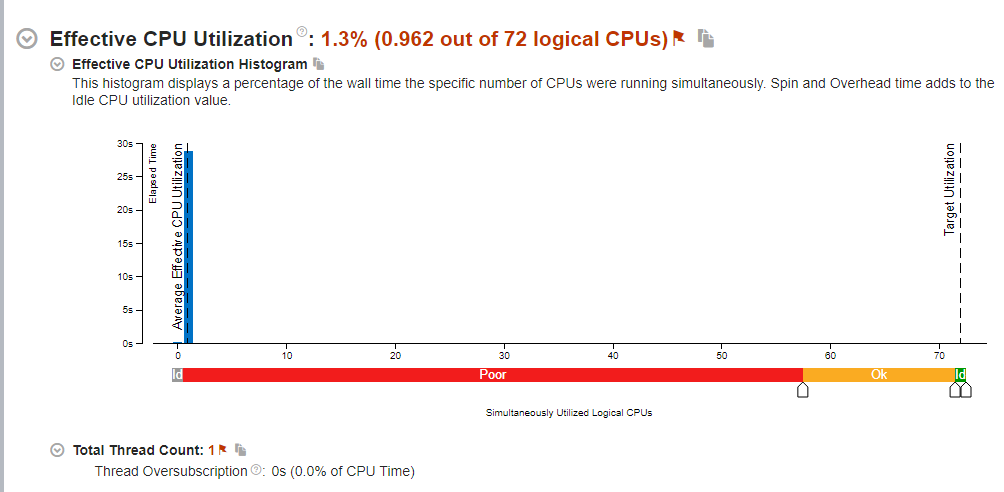
Threading analysis of VTune
This is displaying expected outputs: We don’t use multithreading so we only use 1 Thread.
Since that thread has to wait for the FileIO its utilization is slightly below 100% at 96.2%.
This does show that there could be significant gains from multithreading though (especially since the WavePropagation2d::timeStep() function should be relatively easily parallized and is our main time consumer).
8.3.5 Think about how you could improve the performance of your code
The main performance increases have to originate in WavePropagation2d::timeStep() and FWave::netUpdates().
We found a few things that could be improved in both:
In WavePropagation2d::timeStep() we could increase our cache hitrate heavily by changing the order of the loops:
// iterate over edges and update with Riemann solutions in x direction
for (t_idx l_ex = 0; l_ex < m_nCellsx + 1; l_ex++)
  for (t_idx l_ey = 0; l_ey < m_nCellsy + 1; l_ey++)
to
// iterate over edges and update with Riemann solutions in x direction
for (t_idx l_ey = 0; l_ey < m_nCellsy + 1; l_ey++)
  for (t_idx l_ex = 0; l_ex < m_nCellsx + 1; l_ex++)
This is helping heavily since the array is stored in row-major order and we are iterating over the rows in the inner loop.
This leads to significantly more cache hits since neighbouring cells are accessed sequentially instead of jumping around by m_nCellsx + 2.
We also added some #pragma GCC ivdep to the copying loops to hint the compiler that there are no dependencies between the arrays, it didn’t lead to observable speedup though.
This lead to a performance increase from 43.3 ns to 32.0 ns per cell and iteration.
We also removed the m_step as we noticed we only really need 2 temporary arrays for timestep but can keep all the data in the original arrays without any performance impact.
This should save roughly 14% of the RAM usage (as we only use 6 arrays instead of 7 of the 2D data).
In FWave::netUpdates() we could decrease the number of control flows by replacing conditional statements with the use of temporary arrays:
void tsunami_lab::solvers::FWave::netUpdates(t_real i_hL,
                                           t_real i_hR,
                                           t_real i_huL,
                                           t_real i_huR,
                                           t_real i_bL,
                                           t_real i_bR,
                                           t_real o_netUpdateL[2],
                                           t_real o_netUpdateR[2])
{
  bool l_updateL = true;
  bool l_updateR = true;
  // if both dry do nothing
  if (i_hL <= 0 && i_hR <= 0)
  {
      o_netUpdateL[0] = 0;
      o_netUpdateL[1] = 0;
      o_netUpdateR[0] = 0;
      o_netUpdateR[1] = 0;
      return;
  } // if only left side is dry, apply reflecting boundary condition
  else if (i_hL <= 0)
  {
      i_hL = i_hR;
      i_huL = -i_huR;
      i_bL = i_bR;
      l_updateL = false;
  } // if only right side is dry, apply reflecting boundary condition
  else if (i_hR <= 0)
  {
      i_hR = i_hL;
      i_huR = -i_huL;
      i_bR = i_bL;
      l_updateR = false;
  }

  /* compute l_waveL and l_waveR */

  // set net-updates depending on wave speeds
  for (unsigned short l_qt = 0; l_qt < 2; l_qt++)
  {
      // init
      o_netUpdateL[l_qt] = 0;
      o_netUpdateR[l_qt] = 0;

      // 1st wave
      if (l_sL < 0 && l_updateL)
      {
          o_netUpdateL[l_qt] += l_waveL[l_qt];
      }
      else if (l_sL >= 0 && l_updateR)
      {
          o_netUpdateR[l_qt] += l_waveL[l_qt];
      }

      // 2nd wave
      if (l_sR > 0 && l_updateR)
      {
          o_netUpdateR[l_qt] += l_waveR[l_qt];
      }
      else if (l_sR <= 0 && l_updateL)
      {
          o_netUpdateL[l_qt] += l_waveR[l_qt];
      }
  }
}
to
void tsunami_lab::solvers::FWave::netUpdates(t_real i_hL,
                                           t_real i_hR,
                                           t_real i_huL,
                                           t_real i_huR,
                                           t_real i_bL,
                                           t_real i_bR,
                                           t_real o_netUpdateL[2],
                                           t_real o_netUpdateR[2])
  {
  // initialize net-updates
  o_netUpdateL[0] = 0;
  o_netUpdateL[1] = 0;
  o_netUpdateR[0] = 0;
  o_netUpdateR[1] = 0;
  t_real temp[2] = {};

  // if only left side is dry, apply reflecting boundary condition
  if (i_hL <= 0)
  {
      // if both dry do nothing
      if (i_hR <= 0)
      {
          return;
      }
      i_hL = i_hR;
      i_huL = -i_huR;
      i_bL = i_bR;
      // unhook o_netUpdateL from data
      o_netUpdateL = temp;
  } // if only right side is dry, apply reflecting boundary condition
  else if (i_hR <= 0)
  {
      i_hR = i_hL;
      i_huR = -i_huL;
      i_bR = i_bL;
      // unhook o_netUpdateR from data
      o_netUpdateR = temp;
  }

  /* compute l_waveL and l_waveR */

  // set net-updates depending on wave speeds
  for (unsigned short l_qt = 0; l_qt < 2; l_qt++)
  {
      // 1st wave
      if (l_sL < 0)
      {
          o_netUpdateL[l_qt] += l_waveL[l_qt];
      }
      else if (l_sL >= 0)
      {
          o_netUpdateR[l_qt] += l_waveL[l_qt];
      }

      // 2nd wave
      if (l_sR > 0)
      {
          o_netUpdateR[l_qt] += l_waveR[l_qt];
      }
      else if (l_sR <= 0)
      {
          o_netUpdateL[l_qt] += l_waveR[l_qt];
      }
  }
}
We moved the o_netUpdate initialization to the top.
This allowed us to just “unhook” the pointers from the o_netUpdate arrays if we don’t want to write on them (and replacing them with temporary ghost arrays).
Now we can write on both o_netUpdate’s regardless of whether one of them shouldn’t be updated since we then just write to ghost arrays.
This simplifies the most commmon case of both sides being wet since we save ourselves two booleans, 1 if and 7 to 11 conditional evaluations for the price of 1 two element array.
It poses a minor overhead if both sides are dry since we create an extra local array.
And it should also simplify the wet dry interface since we have the same benefits regarding the booleans and conditionals, though we add up to 2 += operations.
This lead to a performance increase from 32.0 ns to 28.0 ns per cell and iteration.
So in total we managed to decrease the runtime from 43.3 ns to 28.0 ns per cell and iteration, which is roughly 55% improvement in performance / a 35% reduction in runtime.